
Which Wood Is Best for Each Room? A Room-by-Room Guide for Hyderabad Homes
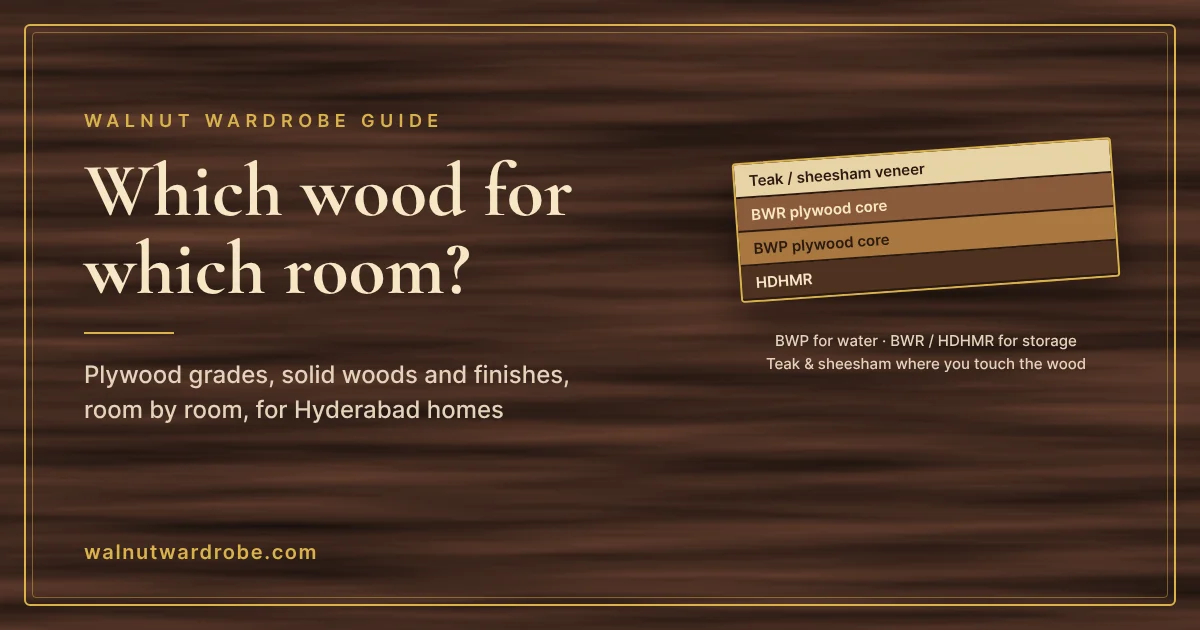
Quick answer: For a Hyderabad home, use BWP (boiling-water-proof) plywood in the kitchen and bathroom, MR or BWR plywood or HDHMR for wardrobes and bedroom storage, and solid teak or sheesham where wood is seen and touched every day: the main door, the pooja mandir, beds and dining tables. Choose the finish (laminate, veneer, acrylic or PU paint) for looks, and the board underneath for water and weight. Avoid MDF and particle board anywhere near water.
Picking wood is the decision that decides how long your interiors last. A wardrobe that looks perfect on handover can sag, swell or get termites within three years if the wrong board was used underneath. This guide explains, room by room, which wood or board we recommend at Walnut Wardrobe, and why.
First, know the 3 kinds of "wood" used in interiors
When a carpenter or designer says "wood", they usually mean one of three things:
- Solid wood: sawn timber such as teak, sheesham (Indian rosewood), sal, rubberwood or imported walnut and oak. Strong, repairable and beautiful, but costly and it can move slightly with humidity.
- Engineered boards: plywood, HDHMR, MDF and particle board. Made from layers or fibres of wood pressed with resin. These are the base (the "carcass") of almost all modular kitchens and wardrobes today.
- Finishes: laminate, wood veneer, acrylic, PU paint or lacquer. This is the surface you see and touch, and it is fixed on top of the board.
Most good interiors use an engineered board for the structure, and a finish for the look. Solid wood is kept for the pieces that deserve it.
The boards explained, from strongest to weakest against water
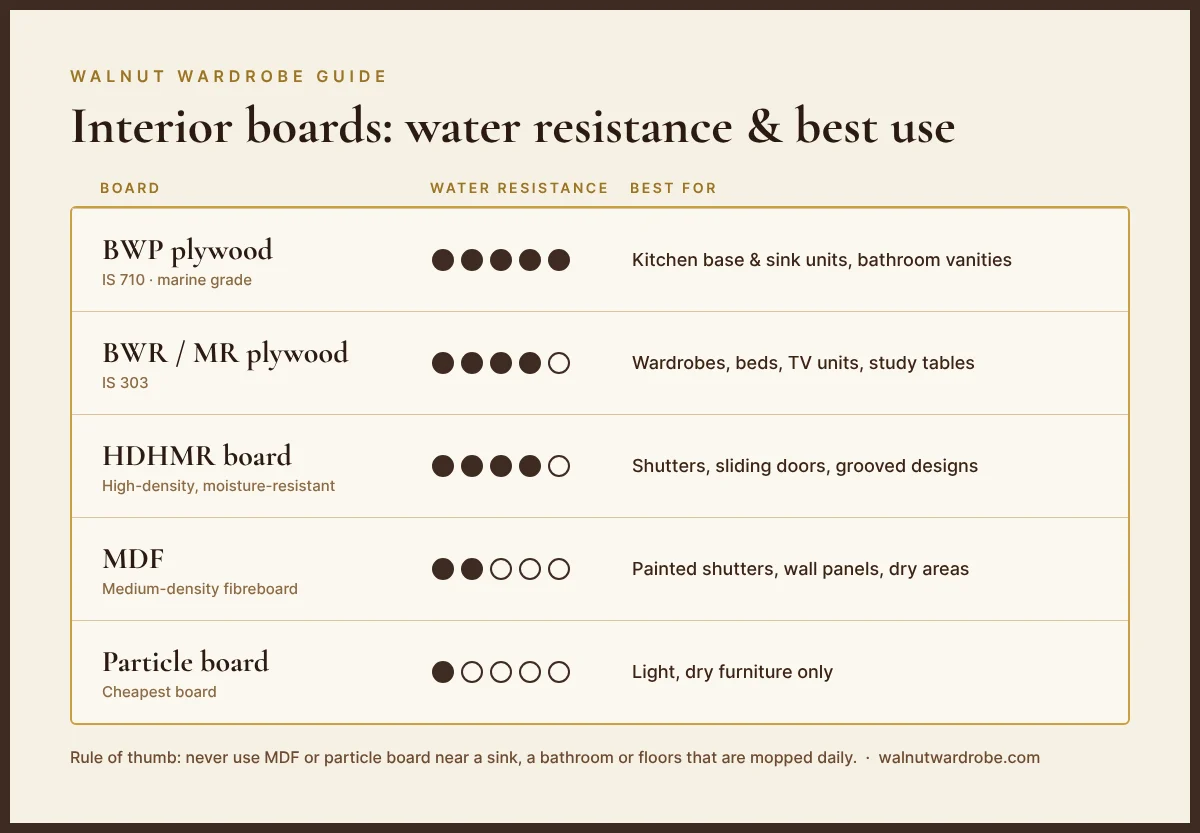
BWP plywood (marine grade, IS 710)
Boiling-water-proof plywood, made with waterproof phenolic resin. The best choice wherever water is a daily fact: kitchen base units, the sink cabinet, bathroom vanities and utility areas. Look for the IS 710 mark printed on the sheet.
BWR and MR plywood (IS 303)
Boiling-water-resistant and moisture-resistant plywood. Strong, holds screws very well, and is the standard choice for wardrobes, beds, TV units and study tables. Look for the IS 303 mark.
HDHMR board
High-density, high-moisture-resistant board. Very smooth and dense, and it does not have the gaps that plywood sometimes has inside. Good for wardrobe shutters, kitchen shutters and areas with routing or grooves. It is heavier than plywood, so we pair it with good hinges.
MDF (medium-density fibreboard)
Very smooth and easy to shape, so it is good for painted shutters, wall panels and decorative work. It swells badly if it gets wet, so keep it away from sinks, bathrooms and floors that get mopped.
Particle board
The cheapest board. Fine for light, dry furniture, but it is weak at holding screws and breaks down with moisture. We do not recommend it for kitchens or wardrobes that you expect to last 10+ years.
Room-by-room guide
Kitchen
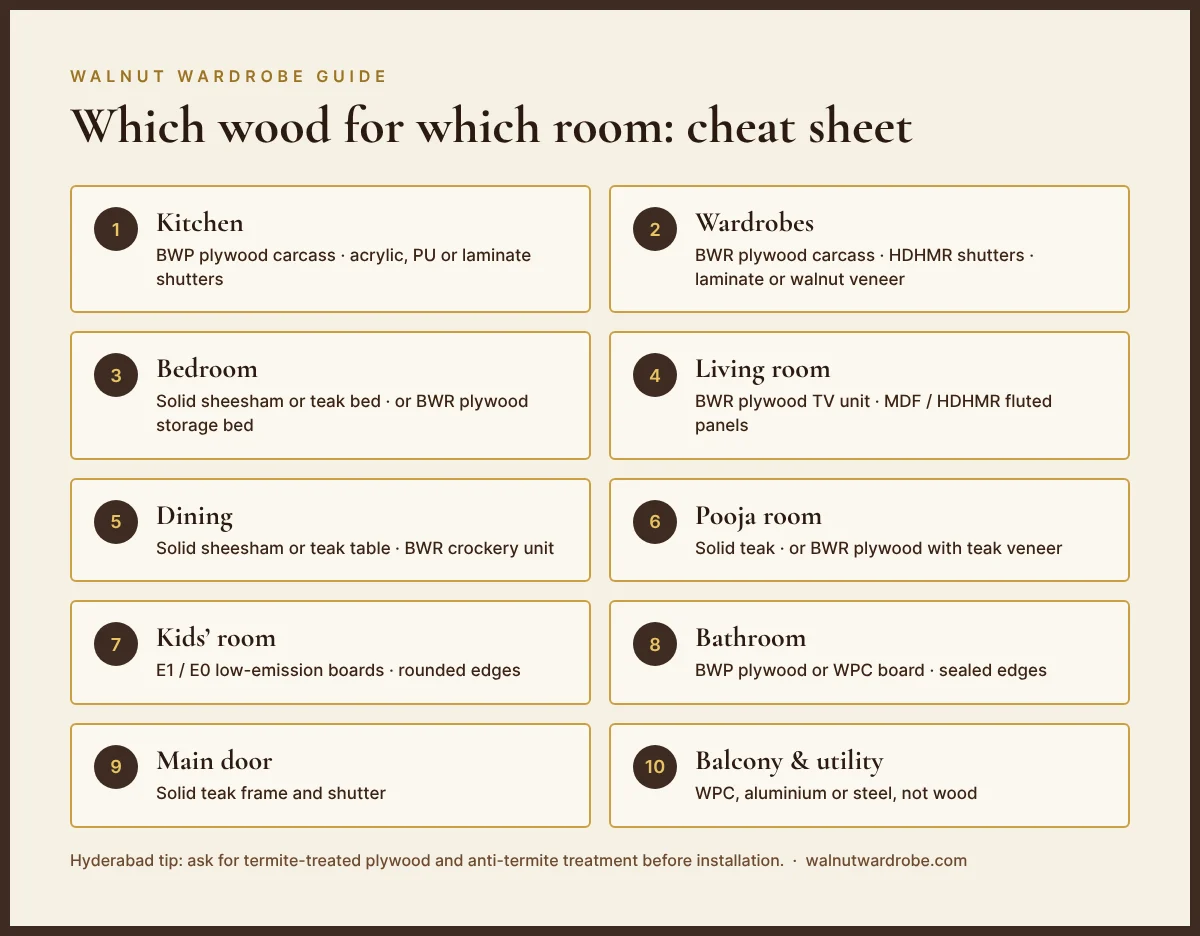
- Carcass (the boxes): BWP plywood (IS 710), at least for the base units and the sink unit. Many families use BWP for the whole kitchen so there are no weak spots.
- Shutters: HDHMR or BWP plywood with laminate, acrylic or PU finish. Acrylic and PU give a glossy, easy-to-wipe look.
- Avoid: MDF or particle board in base units. Steam from cooking and water near the sink will make them swell.
- Tip: ask for edge-banding on every edge, including the hidden ones. Water gets in through raw edges first.
Wardrobes
- Carcass: MR or BWR plywood (IS 303) is the sweet spot of strength and cost. 18 mm for the sides and shelves, and a thinner board for the back panel.
- Shutters: HDHMR or plywood. For sliding wardrobes, HDHMR stays flatter over large heights.
- Finish: laminate for everyday durability. For a premium look, walnut or oak veneer with a matte PU coat gives real wood grain at a fraction of the cost of solid walnut.
- Tip: if a wardrobe sits on an outside wall or next to a bathroom, use BWR or BWP for that side and the back.
Master bedroom: beds and side tables
- Bed frame: solid sheesham or teak for a classic bed that lasts decades, or BWR plywood for a storage bed with hydraulic lift.
- Headboard: plywood or MDF with fabric, veneer or panelling, depending on the look.
- Tip: for storage beds, ask for a plywood base of at least 18 mm, so the mattress does not dip in the middle.
Living room: TV unit, panelling and shelves
- TV unit and shelves: BWR plywood with veneer or laminate. For long floating shelves, ask for a hidden metal support so they never sag.
- Wall panelling: MDF or HDHMR panels with veneer, laminate or paint. Fluted panels in walnut tones are very popular.
- Statement pieces: a solid wood console or coffee table in sheesham or mango wood adds warmth.
Dining room
- Dining table: solid sheesham or teak is the best choice. It takes daily use, hot dishes (with a coaster) and can be re-polished years later.
- Crockery unit: BWR plywood with glass shutters and a veneer or laminate finish.
Pooja room
- Traditional choice: solid teak. It is durable, takes carving beautifully, resists termites well and has a warm golden colour.
- Budget-friendly: BWR plywood with teak veneer, plus CNC-cut jaali in MDF or Corian for the back panel.
- Tip: keep lamps and diyas on a stone or metal base, not directly on the wood.
Kids' room
- Boards: plywood or HDHMR with low-emission (E1 or E0) resin, which releases less formaldehyde into the room.
- Finish: scratch-resistant laminate in fun colours, with rounded corners and soft-close hinges.
- Avoid: glossy glass and sharp-edged hardware at a child's height.
Bathroom vanity
- Board: BWP plywood, or WPC/PVC board, which does not absorb water at all.
- Finish: laminate or acrylic. Always seal the edges.
- Avoid: MDF, particle board and solid wood that is not sealed.
Main door
- Best: solid teak door frame and shutter. It stays stable in Hyderabad's heat, looks better with age and resists termites.
- Alternative: an engineered door with teak veneer and a solid wood frame, for a lower cost with a similar look.
Balcony and utility area
- Avoid wood wherever rain or washing water reaches. Use WPC, aluminium or stainless steel for cabinets, and treated teak or WPC for outdoor seating.
Why Hyderabad homes need a little extra care
- Termites: common in the city, especially in ground-floor flats and independent houses. Ask for termite-treated plywood and an anti-termite treatment of walls and floors before installation.
- Heat and dry summers, humid monsoons: solid wood expands and shrinks with the seasons. Good seasoning (kiln-dried timber) and a sealed finish on all sides prevent cracks and warping.
- Mopping: floors are mopped daily in most homes. Leave a small gap or use a skirting or plinth under base units, so water does not soak into the board.
How to check the quality of plywood on site
- Look for the ISI mark and the IS number (IS 710 or IS 303) printed on every sheet, not just on the top one.
- Check the brand, thickness and grade against your quotation.
- Look at a cut edge: the layers should be even, with no big gaps or overlaps.
- Ask for the bill and warranty card for the boards and hardware.
Our recommendation in one line
Use BWP where there is water, BWR or HDHMR for storage, solid teak or sheesham where you touch and see the wood, and choose a finish that you will love looking at for the next 15 years.
Planning a kitchen, wardrobe or full home in Hyderabad? Talk to Walnut Wardrobe for a free consultation. We will show you real samples of every board and finish before you decide.
Frequently asked questions
Which plywood is best for a modular kitchen?
BWP (boiling-water-proof) plywood, marked IS 710, is the best choice for a modular kitchen, especially for the sink and base units. It is made with waterproof resin, so it does not swell from water or steam.
Which wood is best for wardrobes in India?
For most wardrobes, MR or BWR plywood (IS 303) is the best balance of strength and cost, with HDHMR or plywood shutters. Finish it with laminate for durability, or with walnut or oak veneer for a premium wood look.
Is teak or sheesham better for furniture?
Both are excellent. Teak is more stable, more weather- and termite-resistant and has a golden colour, so it is ideal for main doors and pooja rooms. Sheesham is slightly cheaper, very strong and has a darker, rich grain, so it is great for beds and dining tables.
Is MDF good for kitchen cabinets?
No, MDF is not recommended for kitchen base cabinets because it swells when it gets wet. It is fine for painted shutters, wall panels and dry areas away from water.
What is the difference between BWP and BWR plywood?
BWP (boiling-water-proof, IS 710) is fully waterproof and meant for kitchens, bathrooms and wet areas. BWR (boiling-water-resistant, IS 303) resists moisture but is not fully waterproof, so it suits wardrobes, beds and living room furniture.
How do I protect wooden interiors from termites in Hyderabad?
Use termite-treated plywood, get an anti-termite treatment done on walls and floors before installation, seal all edges of boards, and keep base units raised on a plinth so they do not stay in contact with damp floors.